Transparency Note: This post may contain affiliate links. If you book or buy through them, I may earn a small commission at no extra cost to you. Thank you for supporting the blog!
It’s officially the New Year holiday season in Japan! And if you are anything like me, you are probably freezing your butt off but also loving the vibe. The Christmas lights are gone. They are replaced by the sound of temple bells and that dangerous, mouth-watering smell of yakisoba frying at the street food stalls.
This is Hatsumode (Kanji: 初詣 / Hiragana: はつもうで / Romaji: Hatsumode).
Basically, it is the first shrine visit of the New Year. While I was just happy to have survived the holidays, locals were lining up for hours to welcome the year’s kami (gods) and pray for safety and health.
Klook.comI’ll be honest. My first Hatsumode was pure panic mode. I wanted to participate, but I was terrified of doing it wrong. Do I clap now? Did I wash my hands in the right order? Why is that old lady staring at me?
So, I’ve decided to create this hatsumode guide. If you are standing at the back of a massive line wondering what you got yourself into, worry not. By the end of this post, you’ll know exactly how to wash your hands, bow correctly, and what to do with those coins without looking like a confused tourist.
Preparation: What to Bring and Wear
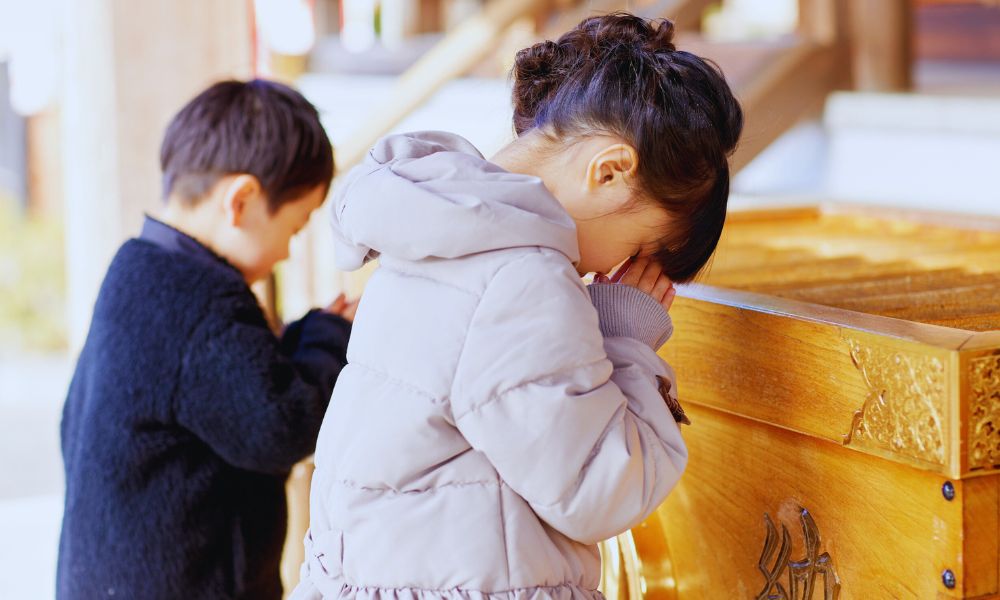
You don’t need much, but there are a few things you should grab before you leave the house to save yourself some stress.
Small Change (Coins)
You will need some coins for the offering box. Any coin technically works, so don’t panic if you only have 100 yen. But if you want to do it like a local, check your wallet for 5-yen coins. These are the copper ones with the hole in the middle.
In Japanese, “5 yen” or Go-en (Kanji: 五円 / Hiragana: ごえん / Romaji: Go-en) sounds exactly like the word for “good luck” or “connection.” It is a fun little word pun. Other aren’t necessarily bad, but the 5-yen coin is definitely the gold standard because of the double meaning. So if you have one, use it!
Dress for the Arctic
I cannot stress this enough. You will be standing outside on stone or dirt paths for a long time. It gets freakin’ cold. Wear your thickest coat and layer up. I usually stick a Kairo heat pack on my back before heading out. I order the big box on Amazon because buying them one by one at the convenience store gets expensive fast, and the wind while waiting in line is no joke.
Old Charms
If you bought a charm or Omamori (Kanji: お守り / Hiragana: おまもり / Romaji: Omamori) last year, bring it with you. You aren’t supposed to keep them forever or just throw them in the trash. There is usually a special box or tent at the shrine where you can drop off old charms to be burned. It’s like a fresh start for your luck!
How to Enter the Shrine (Torii Gate)
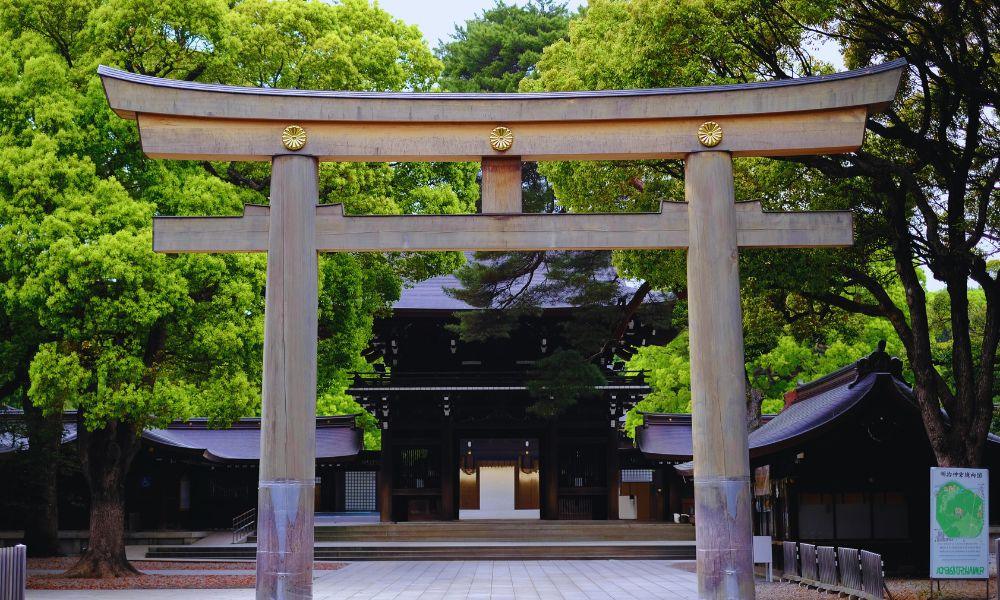
The first thing you will see is the massive gate at the entrance. This is the Torii (Kanji: 鳥居 / Hiragana: とりい / Romaji: Torii). It basically marks the line between the regular world and the sacred world.
I used to just breeze right through these without thinking, but there is actually a proper way to do it. Before you pass under the gate, stop for a second and bow once. It doesn’t have to be a dramatic, deep bow. A quick nod of respect is totally fine.
Also, try not to walk dead center in the middle of the path. That space is technically reserved for the gods to pass through. I always stick to the left or right side just to be safe. It feels a little weird at first, but once you notice everyone else doing it, you will feel like a total pro.
Klook.comThe Purification Ritual (Temizuya)
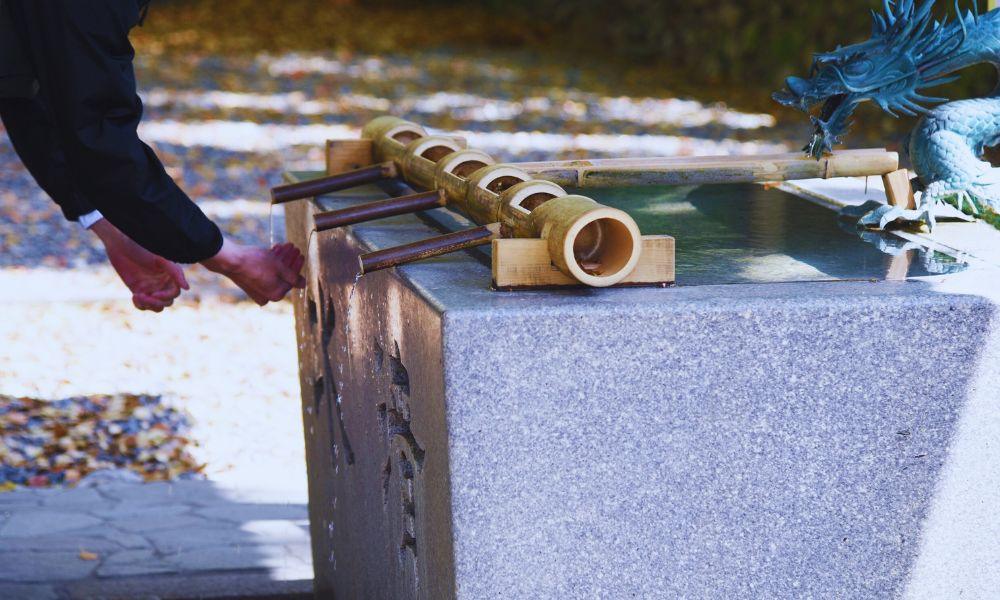
Okay, this is the part that usually freaks people out.
Before you get to the main hall, you will see a little pavilion with water and ladles. This is the Temizuya (Kanji: 手水舎 / Hiragana: てみずや / Romaji: Temizuya). You need to wash your hands and mouth here to “purify” yourself before praying.
I remember watching the person in front of me like a hawk my first time, trying to memorize their moves so I didn’t look stupid. It feels like a pop quiz, but the steps are actually pretty logical once you know them.
Here is the cheat sheet:
- Right Hand First: Pick up the ladle with your right hand and scoop up some water. Pour it over your left hand to rinse it.
- Switch Hands: Hold the ladle with your left hand now and rinse your right hand.
- The Mouth: Switch the ladle back to your right hand. Pour a little water into your cupped left hand and rinse your mouth. Please do not touch the ladle directly to your lips! That is super gross and a big no-no. Just spit the water out gently on the stones below.
- The Handle: Finally, tip the ladle up vertically so the remaining water runs down the handle to clean it for the next person. Place it back upside down.
If this sounds like too much to remember, don’t worry. A lot of shrines actually have signs with pictures showing you what to do. And if you mess up the order, nobody is going to kick you out. Just do your best!
The “Grass Donut” (Chinowa Kuguri)

At some shrines, you might see a massive ring made of grass or reeds standing in the middle of the path. This is the Chinowa Kuguri (Kanji: 茅の輪くぐり / Hiragana: ちのわくぐり / Romaji: Chinowa Kuguri).
When I first saw this, I honestly thought people were just confused or doing some kind of folk dance. They were walking through it, turning around, coming back, and looping around again. It looked dizzying.
But this is actually a powerful purification ritual. The idea is that by passing through the ring, you are wiping away all the bad luck, sins, and exhaustion from the previous year so you can start the New Year with a clean slate.
Note: Not every shrine has this for New Year’s (it is sometimes a summer thing), so don’t stress if you don’t see one. But if you do, here is how to tackle it without bumping into people:
- Bow: Stand in front of the ring and bow once.
- Left Loop: Step through the ring with your left foot and turn left to circle back to the front.
- Right Loop: Step through again, but this time turn right to circle back.
- Left Loop (Again): Step through one last time, turning left again.
- Finish: Bow once more, then step through straight toward the shrine hall.
Basically, you are making a figure-8 pattern. And don’t worry too much, because shrines that put up these Chinowa Kuguris also normally put detailed instructions (complete with cute illustrations) in front of it.
Klook.comHow to Pray: The 2-2-1 Rule
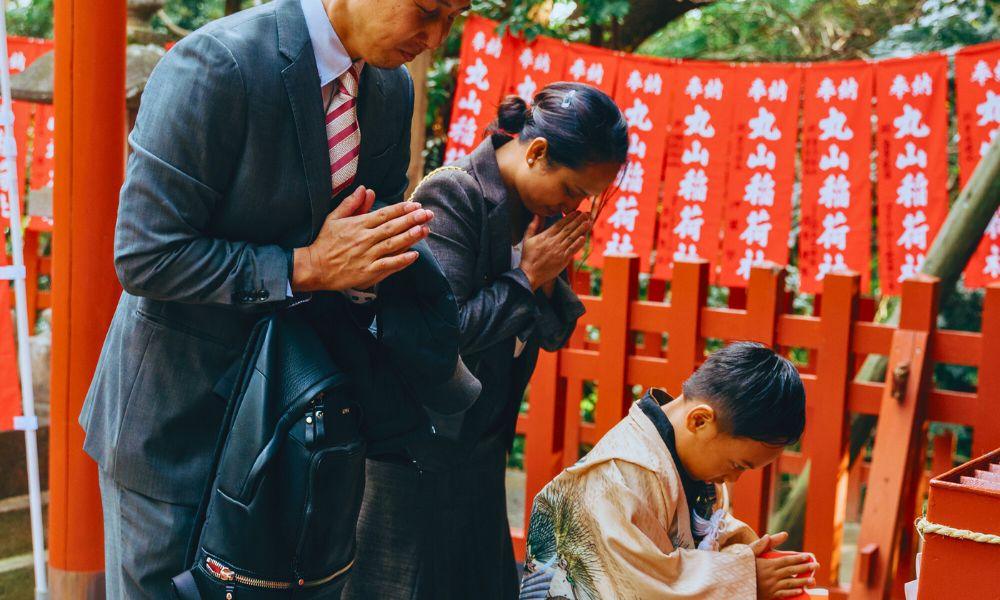
Okay. You have washed your hands. You have walked through the purifying circle. Now you are at the front of the line.
This is the part that used to stress me out the most. I was terrified of doing the wrong number of claps and offending the gods. Or worse. Getting side-eyed by the obachan next to me.
But it is actually pretty simple. Just remember this rule: 2-2-1.
Here is exactly what I do:
1. The Offering
First, gently toss your coin into the offering box. It is called a Saisenbako (Kanji: 賽銭箱 / Hiragana: さいせんばこ / Romaji: Saisenbako). I mentioned earlier to use a 5-yen coin (go-en) if you have one. But if you forgot to save one, don’t freak out. I have definitely thrown in a 10-yen coin in a pinch. The gods aren’t going to strike you down for it. Just try to throw it gently. Don’t slam it in like you are dunking a basketball!
2. Ring the Bell
If there is a bell rope in front of you, give it a good shake to ring it. This is supposed to “wake up” the gods and let them know you are there. If it is super crowded, sometimes they tie these up so you can’t ring them. Just skip this step if that is the case.
3. The Prayer Sequence
This is the main event.
- Bow Twice: Do two distinct, deep bows.
- Clap Twice: Put your hands together and clap.
- Pray: Keep your hands together and say your prayer silently.
- Bow Once: One last bow to say goodbye.
And that’s it! You survived. Now move to the side quickly because the people behind you are probably freezing and want their turn.
After the Prayer: Omikuji and Charms
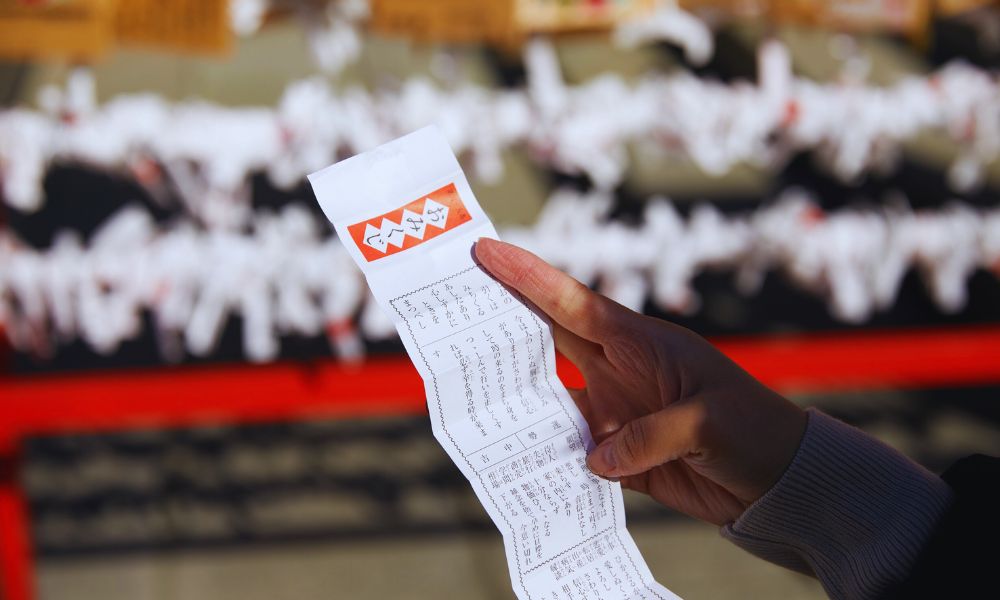
Once the serious stuff is done, you can head over to the booths to see what the gods have in store for you this year. This is honestly my favorite part.
Omikuji (The Fortune Slips)
You have to try the fortune slips called Omikuji (Kanji: おみくじ / Hiragana: おみくじ / Romaji: Omikuji). It usually costs about 100 or 200 yen.
The traditional way is to shake a silver hexagonal box until a numbered stick falls out. You tell the shrine maiden the number, and she gives you the corresponding paper. But be warned. It isn’t always a stick! Sometimes you just pick an envelope from a box, and sometimes they even have vending machines. My son is obsessed with the ones that come inside cute little ceramic animals (which obviously cost more, but they are too cute to resist).
The paper ranks your luck from “Great Blessing” all the way down to “Great Curse.”
The Omikuji Rankings:
- Great Blessing (Kanji: 大吉 / Hiragana: だいきち / Romaji: Daikichi) – This is the jackpot! Keep this one.
- Middle Blessing (Kanji: 中吉 / Hiragana: ちゅうきち / Romaji: Chukichi) – Pretty good.
- Small Blessing (Kanji: 小吉 / Hiragana: しょうきち / Romaji: Shokichi) – It’s okay.
- Curse / Bad Luck (Kanji: 凶 / Hiragana: きょう / Romaji: Kyo) – Yikes.
What if you get bad luck? Don’t panic. You don’t have to carry that bad juju home with you. The custom is to tie the paper strip onto the designated wire or tree branch at the shrine. This leaves the bad luck behind so you don’t have to deal with it.
Omamori (Charms)
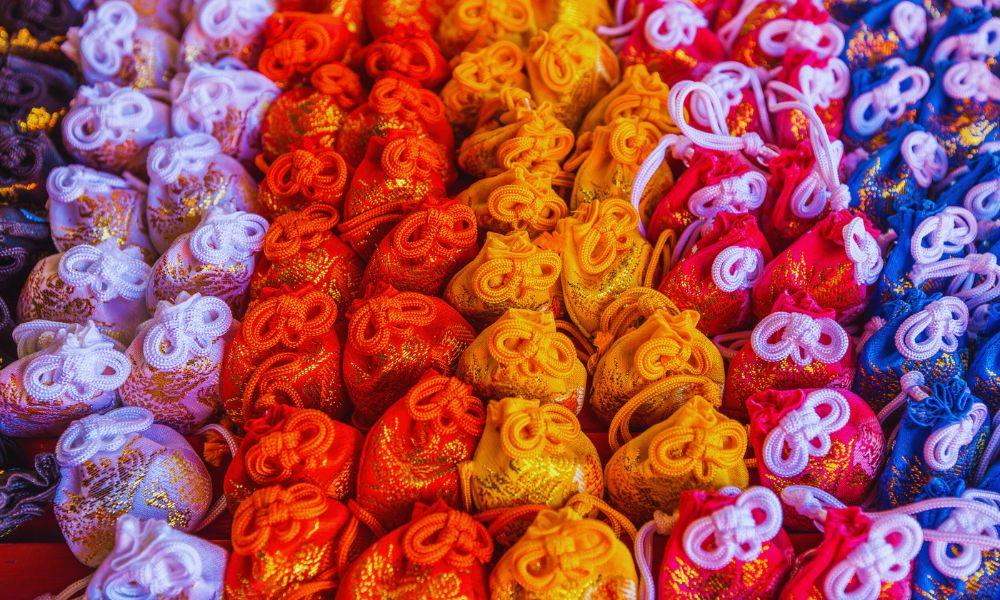
You should also grab an Omamori (Kanji: お守り / Hiragana: おまもり / Romaji: Omamori). These are little fabric pouches that protect you from specific things.
Since becoming a mom, my priorities have definitely shifted. I used to focus on the money and work-related ones, but now I go straight for these two:
- Traffic Safety (Kanji: 交通安全 / Hiragana: こうつうあんぜん / Romaji: Kotsu Anzen). We always get one of these to hang in the car. My husband is a safe driver, but in Yokohama traffic? We need all the divine help we can get.
- Child Safety (Kanji: 子供守 / Hiragana: こどもまもり / Romaji: Kodomo Mamori). These are specifically for kids to keep them safe and help them grow up healthy. I usually clip one onto my son’s backpack.
There is also a general Family Safety charm (Kanji: 家内安全 / Hiragana: かないあんぜん / Romaji: Kanai Anzen) if you just want one charm to cover the whole house.
The “Demon-Breaking” Arrow (Hamaya)
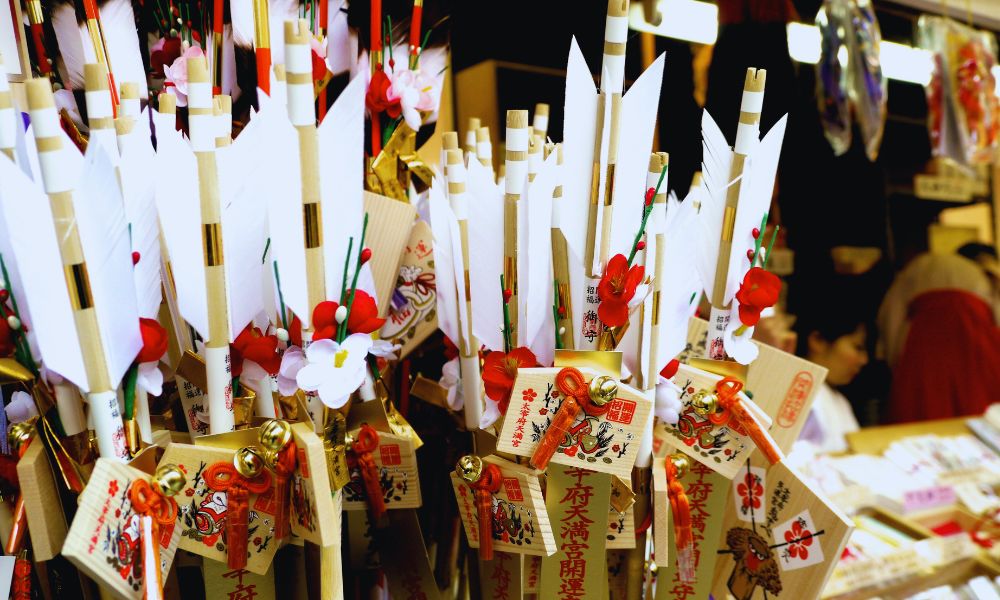
In the new year, you will also see people carrying long decorative arrows. These are called Hamaya (Kanji: 破魔矢 / Hiragana: はまや / Romaji: Hamaya). The name literally means “Demon-Breaking Arrow.” It is supposed to ward off evil spirits and protect your home for the entire year.
They usually have a little wooden tablet attached to them featuring the zodiac animal for the new year. Since 2026 is the Year of the Horse, look for the one with the cute horse painting on it. We buy one every January and place it high up on a shelf in our living room to keep the bad vibes away.
Ema (Wooden Plaques)
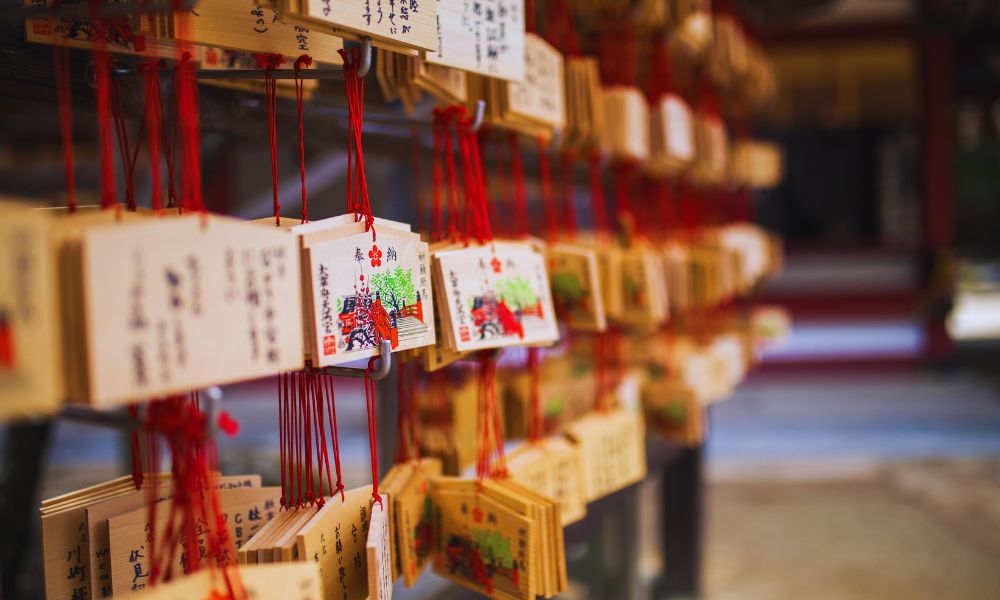
Finally, you might see a wall of wooden plaques with drawings on them. These are Ema (Kanji: 絵馬 / Hiragana: えま / Romaji: Ema). You buy one, write your specific wish on the back, and hang it up. It is really cute to read what other people wish for. You will see everything from “I want to pass my exams” to “I hope my crush likes me back.”
Klook.comThe Fun Part: Yatai (Street Food)
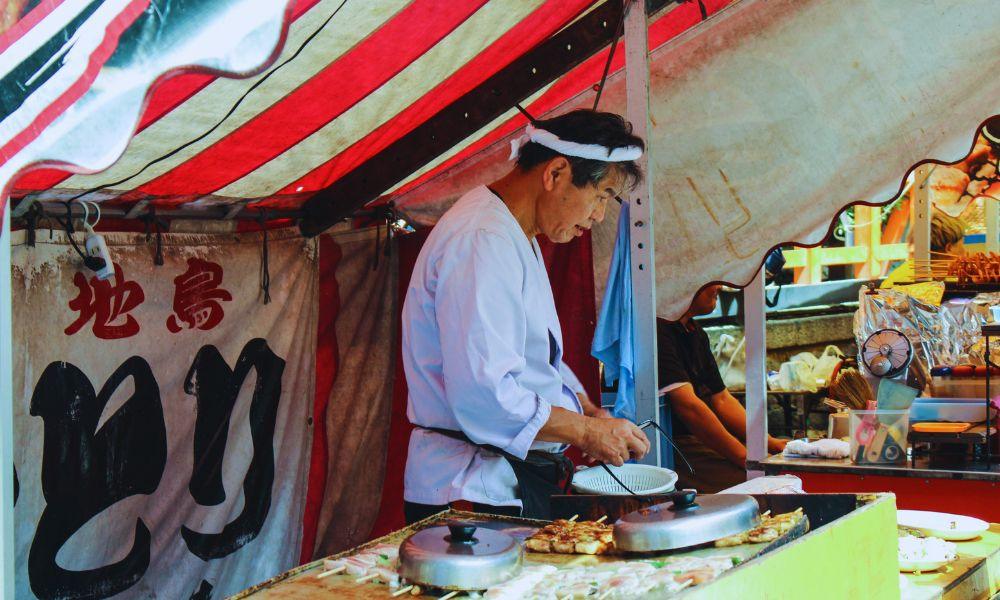
Okay. You prayed. You froze. You survived the crowds. Now it is time for the reward.
As you walk away from the main shrine, you will see (and smell) rows of colorful food stalls. These are called Yatai (Kanji: 屋台 / Hiragana: やたい / Romaji: Yatai). This isn’t just a snack; it’s a full-on festival vibe.
For us, this is usually lunch. We grab a bunch of stuff and find a spot to stand and eat. Just a heads up: most of these stalls only take cash, so make sure you keep those coins and small bills handy!
Here are the three things you absolutely have to try:
1. Yakisoba (Fried Noodles) (Kanji: 焼きそば / Hiragana: やきそば / Romaji: Yakisoba)
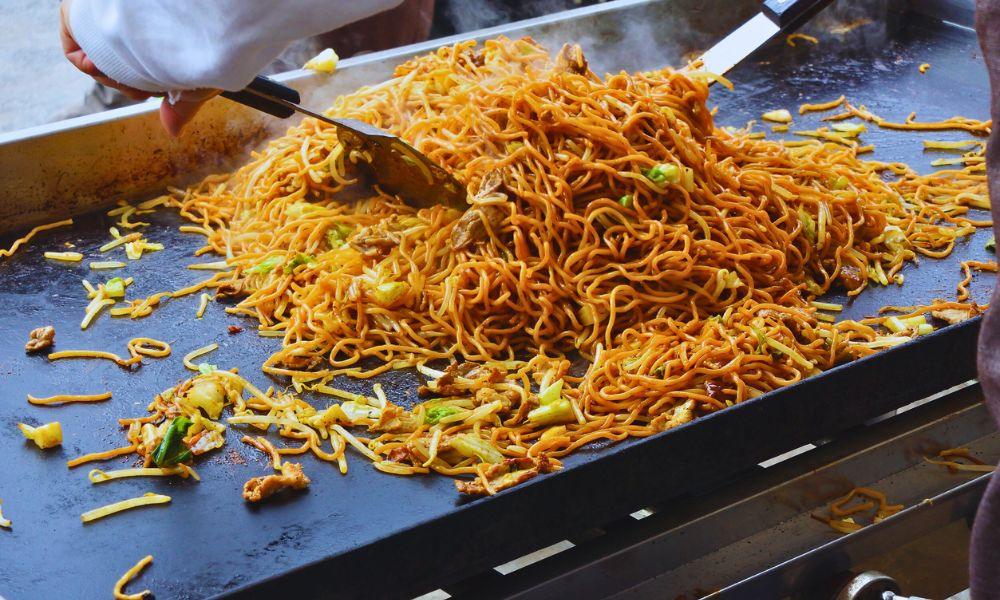
This is the king of street food. It is stir-fried noodles with pork and veggies, usually topped with pickled ginger and seaweed. It tastes a thousand times better eating it outside in the cold than it does at a restaurant.
2. Baby Castella (Sponge Cake Balls) (Katakana: ベビーカステラ / Romaji: Bebii Kasutera)
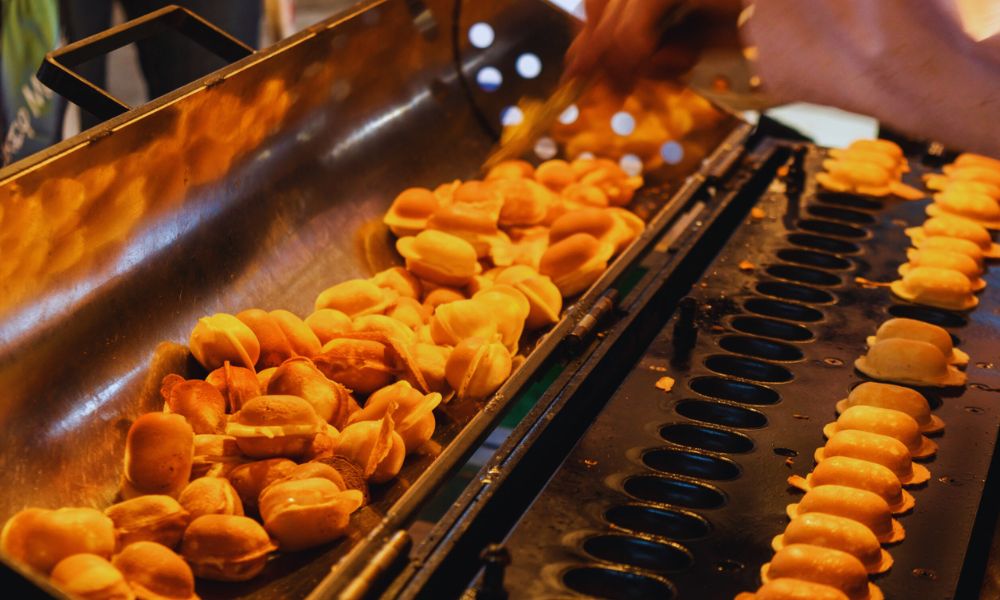
If you have kids, this is a lifesaver. They are tiny, bite-sized sponge cakes that are slightly sweet and fluffy. They usually come in a cute paper bag featuring characters like Pikachu or Hello Kitty. I always buy the biggest bag because my son devours them in seconds (and okay, I eat half of them too).
3. Amazake (Sweet Rice Wine) (Kanji: 甘酒 / Hiragana: あまざけ / Romaji: Amazake)
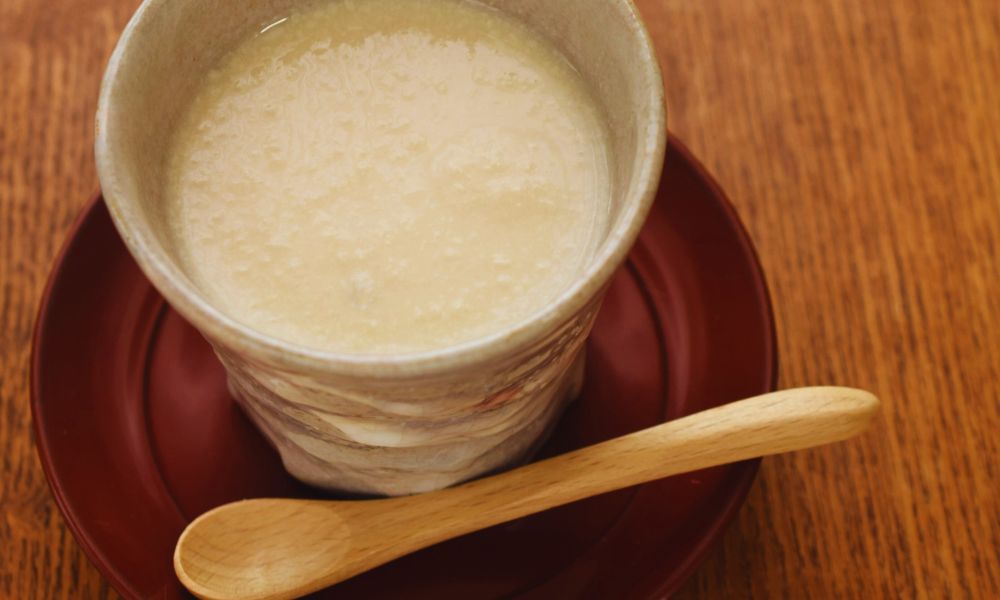
You will see people holding small white paper cups with steam rising from them. That is Amazake. It is a thick, traditional winter drink that warms you up instantly.
But hold on. Before you buy one for your kids, you need to check which type it is. There are two versions:
- The “Boozy” Kind (Sake-Kasu): This is made from sake lees (the leftovers from making sake). It usually has a little bit of alcohol in it and they add sugar to make it sweet. It tastes more like actual sake.
- The “Safe” Kind (Rice Koji): This is called Koji Amazake (Kanji: 米麹 / Hiragana: こめこうじ / Romaji: Kome Koji). It is made just from rice and koji mold. It has 0% alcohol and is naturally sweet without added sugar. This is the super healthy “superfood” one everyone talks about.
Most street stalls sell the Sake-Kasu version (the one with a tiny bit of alcohol). If you are driving or buying it for your kids, just ask the shop owner: “Non-alcohol?” or “Koji?” usually gets the message across!
Mom Tip: Street food is delicious, but it is also messy. Sauce will get on your coat, and your kids’ hands will get sticky. I always keep a pack of Silcot Wet Wipes in my bag. I order the refill packs on Amazon because I go through them so fast, and regular tissues just don’t cut it when you are dealing with yakisoba sauce.
Best Spots for Hatsumode (Yokohama & Kamakura)
Since we live in the Yokohama area, we are honestly spoiled for choice. But picking the right spot depends entirely on how much crowd crushing you can handle.
Here is my breakdown:
1. The Heavy Hitter: Kawasaki Daishi
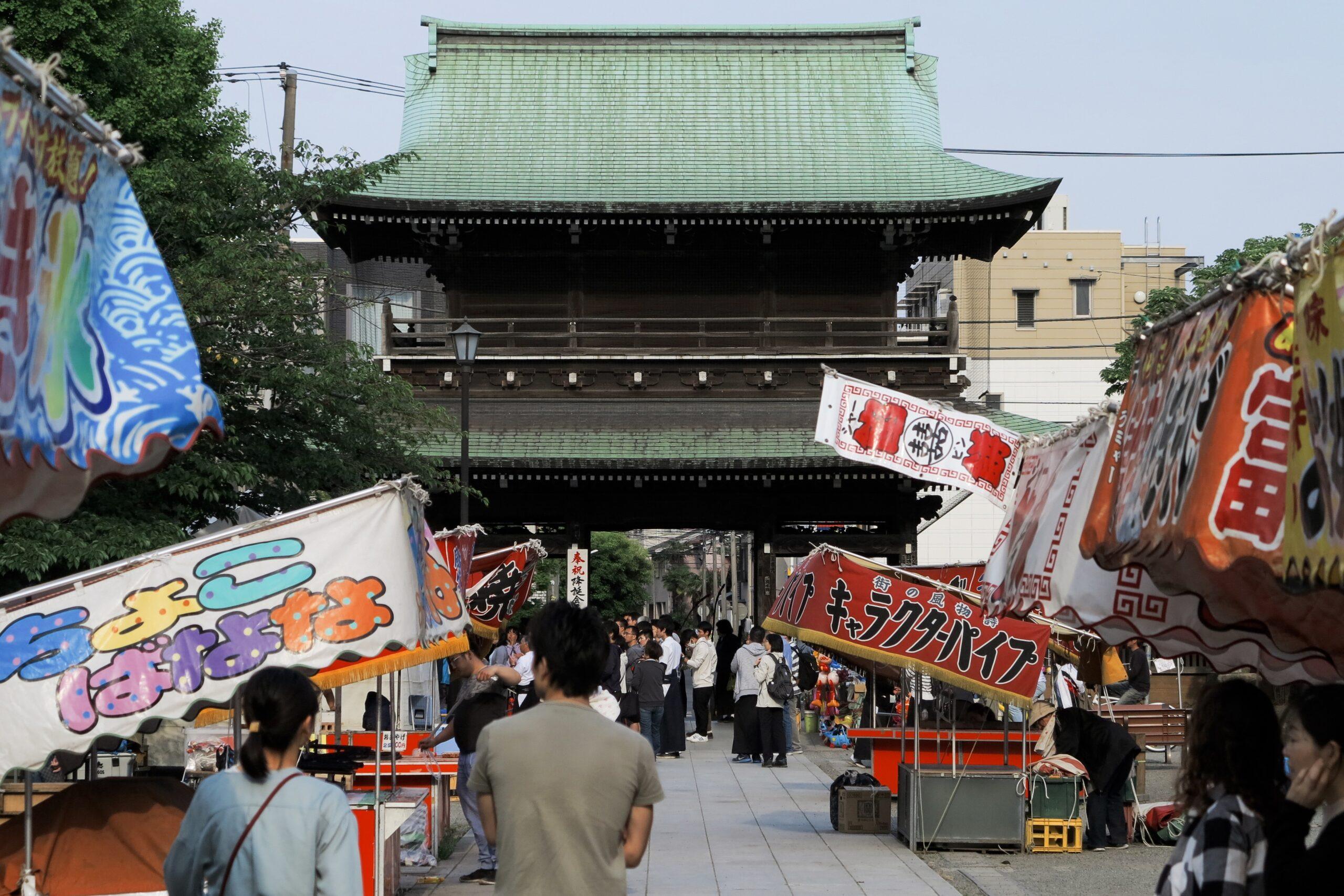
This place is legendary. It is technically a temple, not a shrine, but it attracts millions of people. The energy here is intense. The street leading up to the temple (Nakamise-dori) is famous for its chopping board candy stores where you can hear the staff rhythmically cutting candy with knives.
- The Atmosphere: Loud, festive, packed like sardines.
- Mom Note: Hold onto your kids tight. This is not a place to let them run free.
2. The Photo Op: Tsurugaoka Hachimangu (Kamakura)
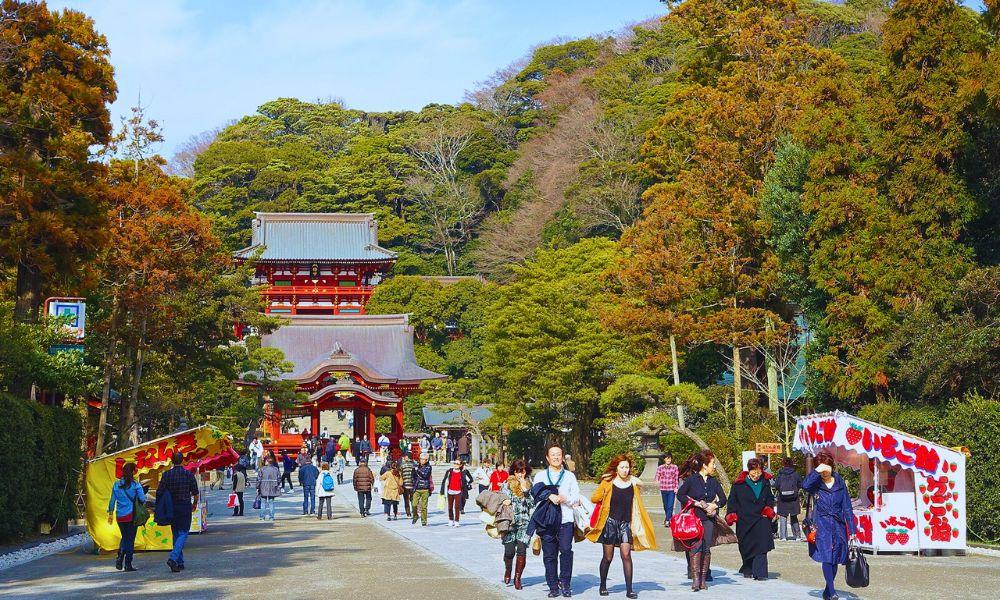
If you want that iconic “I live in Japan” Instagram shot, this is it. It is absolutely stunning with the red bridges and the massive approach from the station.
- The Atmosphere: Historic and majestic.
- Mom Note: Warning! The main hall is at the top of a massive stone staircase. I made the mistake of bringing our heavy stroller here once. While there was no specific ‘parking’ area for the strollers, we saw other families leaving them at some corners at the bottom of the staircase and did the same. It’s Japan, and we were of course able to get our strollers back safely after praying, but I can’t help feeling anxious about it the whole time. If you go here, bring a baby carrier instead. I swear by my Ergobaby Carrier on Amazon for days like this because stairs are the enemy.
3. The Sanity Saver: Your Local Shrine (Ujigami)
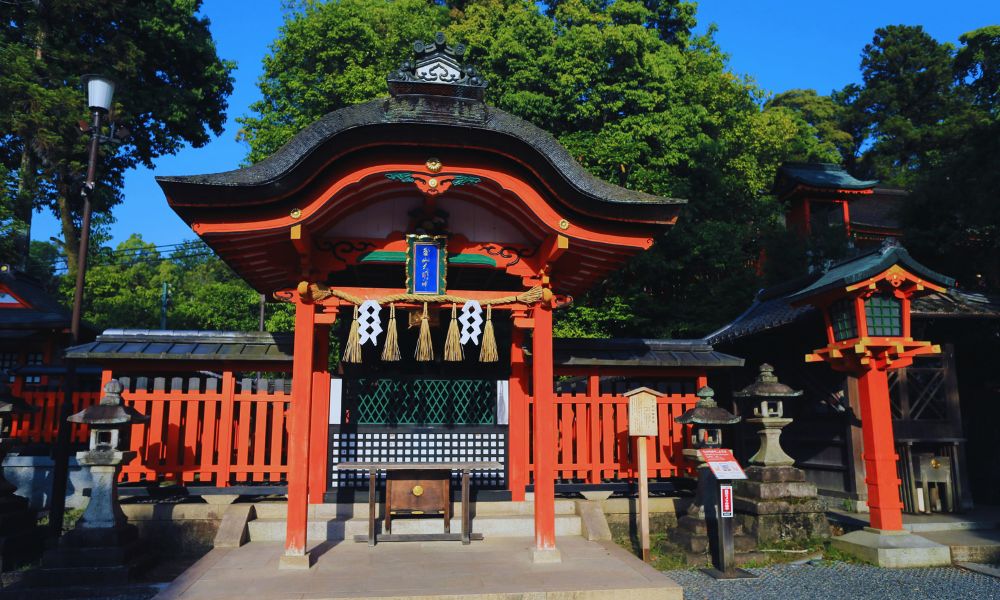
Honestly? This is my favorite option. Every neighborhood has a local deity or “Ujigami” that protects that specific area. You don’t need to travel far. Just search “Shrine near me” on Google Maps. It will be quiet, you won’t have to wait in line for hours, and the locals are usually super sweet to kids. It feels much more personal and “real” than fighting the mobs at the big tourist spots.
Hatsumode FAQs
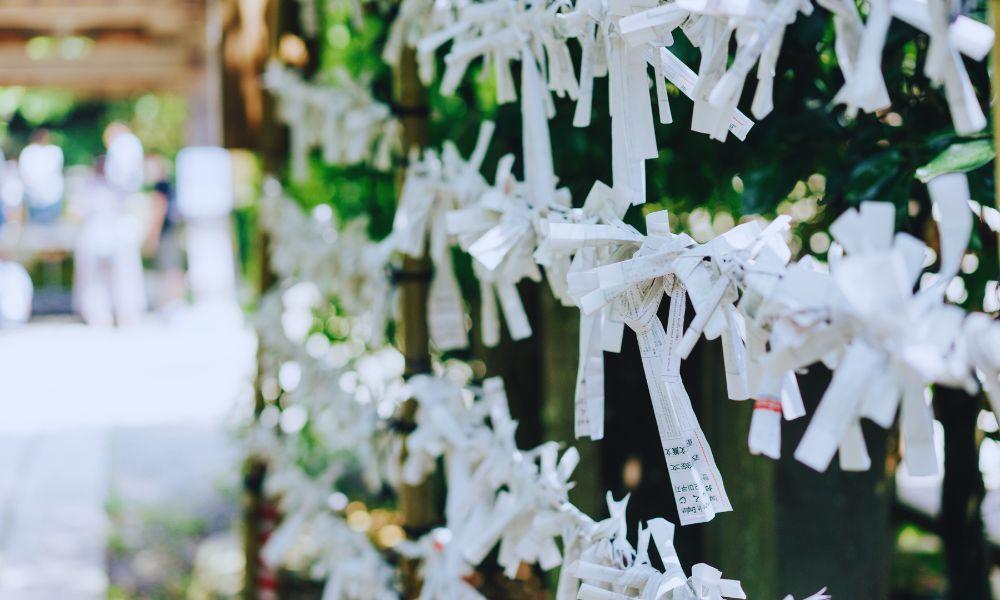
What should I do if I get a bad fortune (Kyo)?
First of all, don’t cry! You don’t have to take the bad luck home. If you pull a “Curse” or Kyo (Kanji: 凶 / Hiragana: きょう / Romaji: Kyo), just go find the designated wire fence or tree branch nearby covered in white paper strips. Tie your bad fortune there using your non-dominant hand (if you can!). This symbolizes leaving the bad luck behind at the shrine so you can leave fresh.
Can I visit a temple instead of a shrine?
Yes! Japanese people visit both. But there is one major difference in the prayer style: Do not clap at a temple.
How do you tell them apart? Look at the entrance.
- Shrine (Has a Torii Gate): Bow Twice, Clap Twice, Pray, Bow Once.
- Temple (Has an Incense Burner): Bow Once, Pray (hands together but NO clapping), Bow Once.
If you forget which is which, just look at the person next to you and copy them. That is my survival strategy.
Is Hatsumode religious?
It is, but it is also very cultural. You will see people who aren’t super religious still lining up just because it is a tradition. It is kind of like how people celebrate Christmas even if they don’t go to church. Don’t worry about being an outsider. As long as you are respectful, you are welcome.
How much money should I really throw?
There is no set fee. You can throw 1 yen or 10,000 yen. The gods don’t have a price list. But like I mentioned before, the 5-yen coin (Go-en) is the most popular because it sounds like “good luck.” If you don’t have one, just use whatever small change you have. It is the thought that counts!
Klook.comReady to Use This Hatsumode Guide?
So, there you have it. You are now officially ready to tackle Hatsumode without looking like a deer in headlights.
It is going to be freezing. It is going to be crowded. And if you bring your kids, there is a 50% chance someone will cry before you even reach the offering box. But honestly? It is one of those “Only in Japan” moments that you just have to experience.
Don’t stress too much about getting the angle of your bow perfect or memorizing the Japanese names for everything. The fact that you are there showing respect is enough. Plus, the street food at the end makes it all worth it.
Want More Japan Life Chaos? If you found this guide helpful (or just want to see me struggle through more parenting adventures), look around the rest of the blog or head over to my YouTube Channel. I have plenty more guides, tips, and general babblings of a foreign mom trying to navigate life here in Yokohama.